
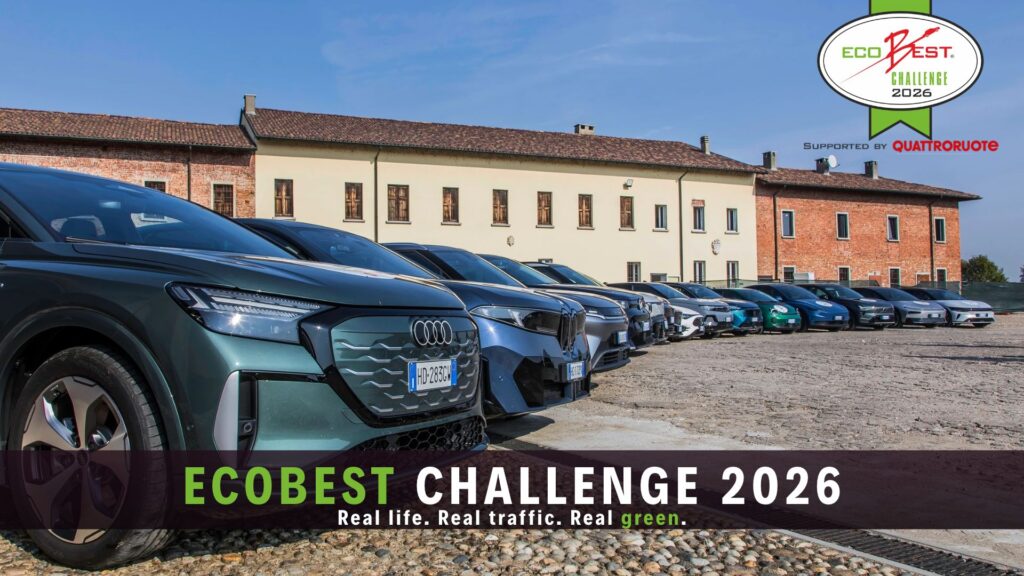
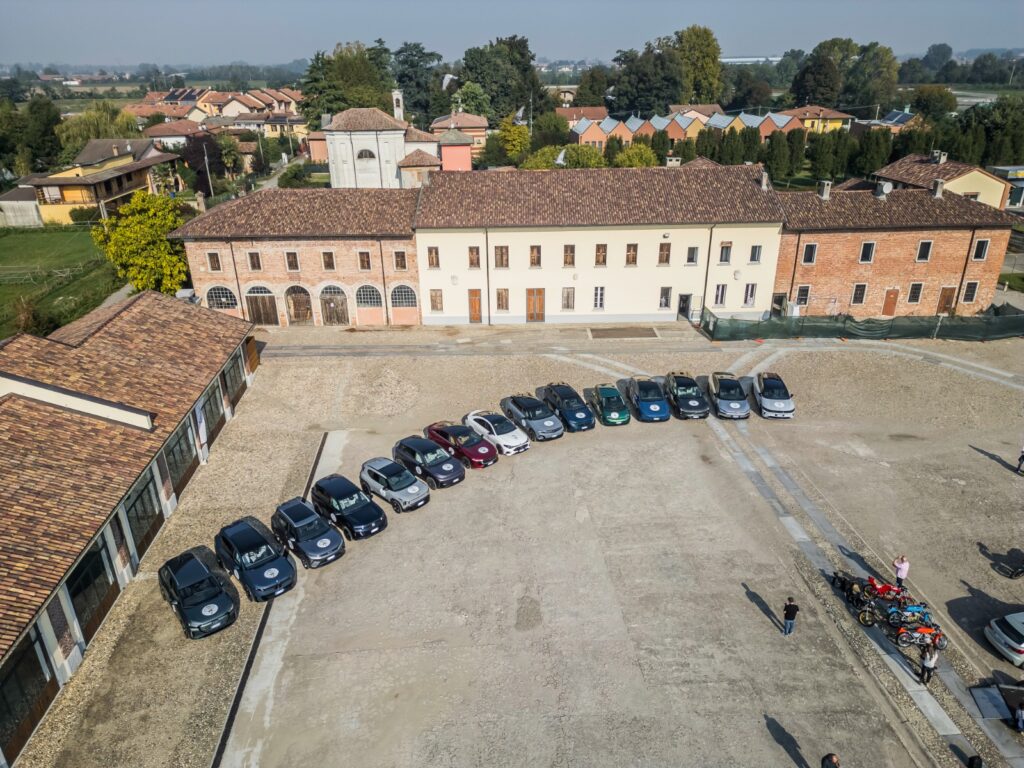
Helping European motorists understand how today’s electric cars really perform, the independent international organisation AUTOBEST has completed the 2026 edition of its ECOBEST Challenge end- September 2026, in Vairano, Italy.
Fifteen new EVs from 15 different manufacturers were driven under identical, reproductible, real-life traffic conditions and assessed through 7 tests and proprietary indexes – facts and figures that matter to anyone considering, or already driving, an electric car.
The unique, real-life testing methodology developed and refined by AUTOBEST has been certified by the independent Bureau Veritas organization for the 4 -th year in row.
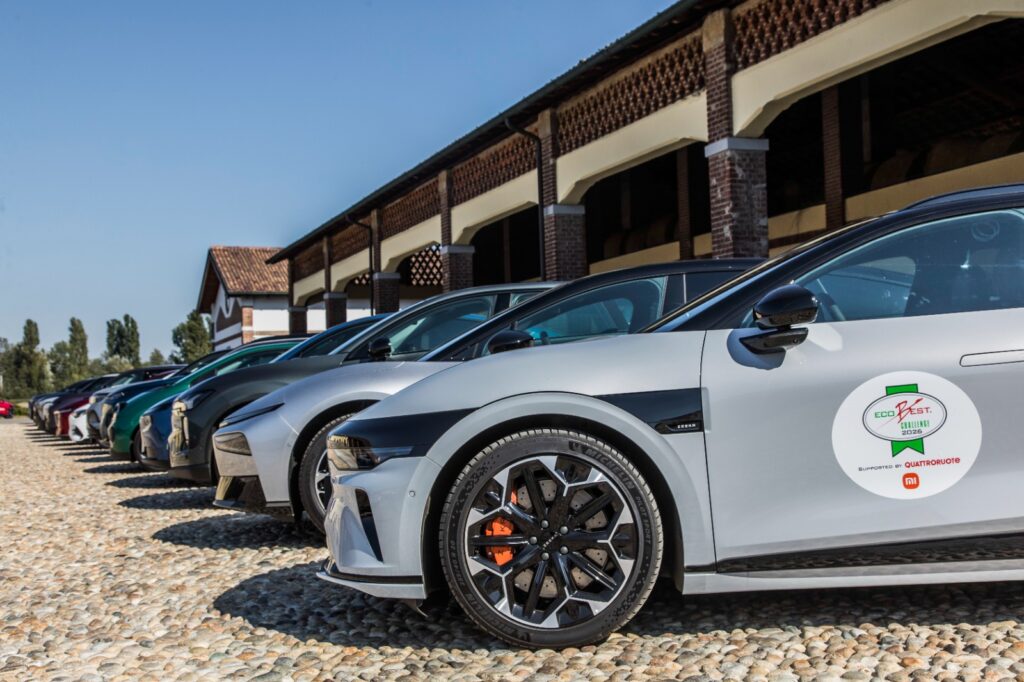
In alphabetical order, the 15 cars tested by the AUTOBEST jurors in the 2026 ECOBEST Challenge were: Audi Q4 e-tron, BMW iX3, BYD Atto 2, Citroën ë-C5 Aircross, Kia EV2, Leapmotor B10, Mazda6e, Mercedes-Benz CLA 250+, Opel/Vauxhall Grandland Electric, Peugeot e-5008, Renault Twingo, Tesla Model Y, Volvo EX60, Xpeng P7+, Zeekr 7GT.
For the first time in ECOBEST Challenge history, Ferruccio Lamborghini, scion of the iconic Lamborghini family and grandson of the legendary founder of the Lamborghini industrial conglomerate, joined the event as a special guest, accepting the personal invitation of Dan Vardie, Founder and Chairman of AUTOBEST and creator of the ECOBEST Challenge.
Ferruccio took an active part in the entire testing program, driving the electric vehicles alongside the AUTOBEST jury members, following every stage of the process and showing genuine interest in the methodology and real-world results.
His presence sends a powerful message: beyond the prestige of a renowned name, his openness and enthusiasm reflect the importance of sustainable, efficient, and affordable mobility, reinforcing the relevance of the ECOBEST Challenge in shaping the future of everyday motoring.
The headline result of 2026 comes from Renaut Twingo which is making a new EcoC 2 index of 8,33 km for 1 kWh of battery! This is best energy efficiency in the ECOBEST Challenge history, passing the previous record of previous generation of DACIA Spring with 8,17 km, followed by Leapmotor T03 with 8.06 km. In fact, these are the only EV’s in the almost a decade history of ECOBEST Challenge history with more than 8 km driven with 1kWh of battery. This year, the second best EcoC 2 is coming from Tesla Model Y with 7,77 km. On the third place is coming Mercedes Benz CLA with 7,21 km per 1kWh. All the other 12 EV’s in test came with less than 7 km/ 1kWh. These results are clearly showing that is room for improvement the energy efficiency.
On the good news, this year we recorded no less than 4 models -Xpeng P7+, Zeekr 7GT, Volvo EX60, BMWiX3- able to reach 100 km range in only 4 minutes in DC fast charging. The fifth in the ranking, Mercedes Benz CLA was charging 100 km in 5 min while Tesla Model Y with 6 min came on the sixth position. There is a remarkable increase in the DC fast charging capabilities shown in the new generations of EV’s . With these results, the range is even less of concern compared with last year tested models. Overall, the 2026 results confirm that electric mobility keeps progressing step by step rather than by leaps.
At this edition, it was used 400 kW DC fast charging stations, the biggest power , so far, in the history of ECOBEST Challenge. All the cars mentioned are presenting a big fast recharging capacity, opening a new competition for charging stations with higher power. Although fast charging stations with power more than 400 kW are already existing in Europe, their number is very small, most of car users practically having no access to these stations.
“At this edition we establish an all-time record for EcoC 2, probably the most important criteria now and in the future: energy efficiency! The new Renault Twingo is offering more than 8,33 km/ kWh. Although is great news, we believe that we are still in the infancy of a remarkable energy efficiency on board of EV’s. Years ago, we challenged the industry to reach 10 km/ kWh and more OEM’s independently declared to fix this figure as a target. We are still far away and with the rhythm we noticed in the last years, probably the 10 km/ kWh will not be reached by 2030. On the good news we see a more consistent DC fast charging capabilities of the new EV’s, offering a less range anxiety than any time before. This is first of all thanks to the new chemistry achievements in the new batteries. Even more on the great news, new models with even bigger capabilities in fast charging are announced to come. But the DC fast charging stations must also keep pace with these developments. We need many more stations to offer 500 kW power and more. Finaly, another increasing challenge everywhere in Europe is the grids capacity in offering such high power available to every charging station. Today is not yet the case and this is concerning. European governments must take serios actions to stabilize the grids for the increasing demand for electric energy. Especially in the context of the oil crisis accelerated by the Middle East conflict. said Dan Vardie, Founder and Chairman of AUTOBEST and creator of the ECOBEST Challenge.
“Year after year, the ECOBEST Challenge remains a unique test in Europe, thanks to the quality and accuracy of its measurements. We use Quattroruote’s ISO 9001-certified testing procedures, with an additional independent verification by Bureau Veritas. This double check makes our results reliable and transparent.As Dan Vardie pointed out, the 2026 results confirm that electric cars continue to improve, often through small steps that add up over time. They also show that range is not everything: efficiency, charging performance and energy losses are just as important.Above all, we are not for or against electric cars, petrol cars or any manufacturer. Our figures are not meant to prove anyone right or wrong. They simply show reality as it is, giving European motorists reliable information about the cars they drive. And that matters more than ever, in a world where stories too often get more attention than facts.“, declared Alessio Viola, senior editor at Quattroruote and Vice-President of the AUTOBEST Jury, in charge of the ECOBEST Challenge.
With the data published by AUTOBEST, motorists can judge whether they are ready to switch from an ICE car or even from a hybrid of any kind to an electric one, and whether the model they are considering will meet their everyday needs. The real-life testing methodology developed and refined by AUTOBEST is certified by the independent Bureau Veritas organisation.
The 2026 ECOBEST Challenge introduced a technical premiere in collaboration with ZEEKR: for the first time in the history of the event, Vehicle-to-Load (V2L) technology was featured as part of the Challenge.
Within this collaboration, a ZEEKR vehicle operated as the Challenge’s dedicated V2L “energy mobile support”, demonstrating how an electric car can act as a mobile power source.
The demonstration offered a practical showcase of V2L’s versatility and real-world potential. It extends the role of an EV beyond mobility, proving that the energy stored in its battery can be accessed whenever and wherever it is needed.
Introduced five years ago, AUTOBEST key index named EcoC 2 represents the quintessential idea of EV energy efficiency. In this reduced time frame, EcoC 2 already achieved an important recognition among EV consumers and the industry. It is simply how many kilometers of actual range one kWh of the battery can offer for a specific model. This edition marks a new record, giving hopes for future evolution to the 10 km/ kWh target set by ECOBEST Challenge few years ago.
We measured the AC and DC Fast Charging processes with great accuracy using 22 kW AC stations and 400 kW DC stations. Talking about DC Fast Charging capabilities, we increased the station power to keep the pace with the latest developments. However, having very powerful stations – it is already announced the 1000 kW power station- is a longer process. In the meantime, millions of car users will use the existing network which is suffering not only for lower charging power capabilities but also from the lack of enough power coming from the grid.
This year AC Fast Charging test was recording no less than 4 models with 4 min for 100 km range. A similar time was recorded just once, in 2023, with Hyundai Ioniq 6. It is also important to highlight the fact that in the longest time for fast charging 100 km was 32 min in 2025. Each car’s maximum charging capacity determines this time. And as we noticed: the smaller the car, the smaller charging capacity it has.
Two important notes:
Using the `random human factor` concept, ECOBEST Challenge is the only European certified project to reveal the real range results show compared with official WLTP. To be very clear, there is no conflict -or mistake- between the EcoC 1 and WLTP range. The first one is a result of `real life, real traffic, true data` approach and WLTP is a test provided by European Commission with the aim of coming closer to the reality of driving. ECOBEST Challenge recommends all the OEM’s having the cars in test to present both figures to the press and motorists. This is the most transparent way a manufacturer can provide such relevant figures to its customers. We also recommend all the car users to consult the findings of ECOBEST Challenge for been very well informed about the EV’s green real credentials. This year, all the 15 cars in test delivered real range below the WLTP official range.
The ECOBEST Challenge is one of the only independent tests in Europe measuring what happens after the battery reserve indicator/ available km reaches zero. All the cars have been driven to a total depletion of the battery and a final stop. AUTOBEST is happy to deliver good news to all motorists: in all cars there is still life in the battery once it indicates zero on the cluster. This year no car ‘died’ immediately after the battery cluster indicated zero.
Although it is very important to know how `much life you still have in your apparently empty battery`, AUTOBEST recommends keeping this as a strategic reserve of the battery and better never entering the situation to use it.
Another interesting result of the ECOBEST Challenge is the energy needed to fully charge cars with totally depleted batteries- index EcoC 3. All the vehicles required more energy than the capacity of the batteries – between 4,7% (5.9% in 2025) and 18,16% (21.3% in 2025).
The additional consumption when recharging has been investigated and it has several causes. Some energy is lost when transformed from AC (grid) to DC (battery).
Some energy powers all the car systems used for charging, mainly the inverter but also the software, the socket, and everything related to the process. Energy is also used to cool the battery during the process, this energy increases with fast charging, especially under hot climatic conditions.
The state of the batteries and the charger type may also generate some losses. To get precise and complete data in the 2025 ECOBEST Challenge, AUTOBEST operated in close cooperation with Quattroruote and its Centro Prove, using Power checK Control (PKC) to analyze and certify all electric cars. Since it is connected in real-time with the car via a Bluetooth Onboard Diagnostic II (OBDII) dongle, PKC accesses many parameters of the actual battery status: the SoC (State of Charge), the SoH (State of Health), the temperature, the car’s speed, weather conditions, the power used or regenerated by the car, the power during the charging phase and other relevant factors. EV drivers may get this expertise in daily life using Power Cruise Control: PCC suggests the right charging points along the route and precisely calculates how many kWh you need to charge. And to use it in the best way, this software gives constant feedback to the driver via an intuitive interface called the Heaven-Hell indicator.
Please see the Annex tables with all the relevant data to discover all results on our website.
The tests took place in Vairano, near Milan, Italy, at the Quattroruote proving ground, on from September 28th to 30th. AUTOBEST’s professional motoring journalists drove 15 electric cars, all priced below €65,000 before taxes, to answer the questions buyers most often ask about EVs.
AUTOBEST thanks its partners for making the 2026 ECOBEST Challenge possible:
The ECOBEST Challenge 2026, supported by Quattroruote, is the first and only certified European independent real-traffic test of mainstream EVs designed to reveal their true green credentials. All cars were tested with exactly the same methodology, built around the daily commuting habits and driving behavior of typical European motorists. Pioneering the “human random factor”, it is the closest concept to the ideal average customer.
Selection criteria. Only new, popular EVs on sale in Europe were selected, with a standard entry-level list price below €65,000 excluding taxes and incentives. Full specifications and all measurement data for each car are available in the annex.
The ECOBEST Challenge is not for or against any model or brand. It is not a classic magazine comparison test, a record-breaking range attempt or a performance test. It publishes the results of its measurements, based on its proprietary indexes, without rankings or comments, as a basis for European motorists’ own decisions.
Certified methodology. For the fourth consecutive time, the 2026 edition received the Bureau Veritas certification, recognizing its genuine, comprehensive and consistent approach to testing EVs in real traffic and assessing their real-life green credentials in an unbiased way.
Data collection. The Challenge used a dedicated app measuring key data through a direct connection to a Motorola mobile terminal in each car. Power Check Control (PKC), developed by the Italian company Power Cruise Control, connects to the car in real time via a Bluetooth OBD-II dongle. It records state of charge, state of health, battery temperature, speed, weather, power used or regenerated, and charging power for both AC and DC sessions. These data are available on request.
As organizer of the ECOBEST Challenge, AUTOBEST stands behind all results, obtained through a test performed in exactly the same way for every car and certified by Bureau Veritas. AUTOBEST is confident these results are much closer to reality than WLTP homologated figures and invites European motorists to use them according to their own needs.
The aim is not to rank the 15 cars but to provide a realistic reference for a better-informed choice. No car can perfectly satisfy every need; each buyer should decide based on their own requirements. The results reflect specific conditions of route, temperature and test cycle. AUTOBEST does not claim to reach the absolute ideal average, but believes it comes very close and offers the fairest possible comparison.
AUTOBEST made every effort to collect the official homologated data for all cars tested. Where a manufacturer did not publish or provide specific data, AUTOBEST determined it from all available information.
ECOBEST Challenge is a project of AUTOBEST, created by Dan Vardie, Founder and Chairman of AUTOBEST.
For more information: www.autobest.org · www.ecobestchallenge.org
Press contact: pr@autobest.org
Social media: Instagram: ecobest_challenge · LinkedIn: Ecobest Challenge · Facebook: Ecobest Challenge